NASA’s 2025 Moon Missions: Lunar Rehearsal & New Frontiers
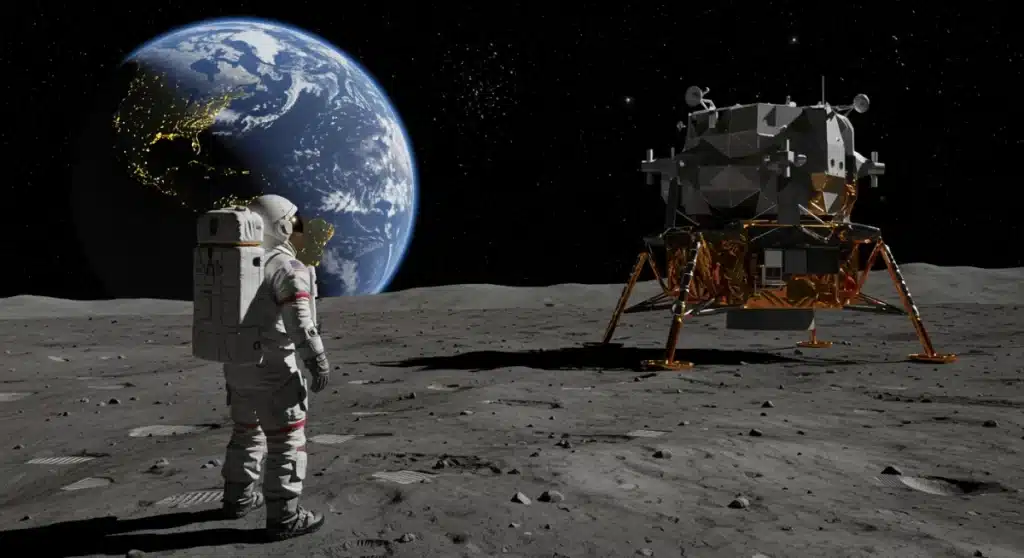
NASA has officially confirmed two pivotal missions for 2025, featuring a crucial human landing rehearsal on the Moon, a significant step towards sustained lunar presence, alongside another ambitious deep space initiative, advancing humanity’s reach beyond Earth.
NASA 2025 Moon Missions are set to redefine humanity’s presence in space, with the agency recently confirming two major endeavors. These missions, poised for launch in 2025, include a critical human landing rehearsal on the Moon, marking a significant stride towards sustained lunar exploration and eventual human settlement. This announcement underscores NASA’s unwavering commitment to pushing the boundaries of scientific discovery and technological innovation.
The Artemis Program’s Next Giant Leap: Lunar Rehearsal
NASA’s ambitious Artemis program is rapidly progressing, with 2025 slated for a crucial milestone: a human landing rehearsal on the Moon. This mission is not merely a symbolic gesture; it is an essential operational test designed to validate the complex procedures, technologies, and human capabilities required for future lunar surface operations. The success of this rehearsal will be paramount in ensuring the safety and effectiveness of subsequent crewed landings.
The rehearsal will involve a series of meticulously planned activities that simulate a full human landing. From orbital maneuvers to descent and ascent profiles, every phase will be scrutinized. Engineers and astronauts have been collaborating extensively to refine these procedures, learning from past Apollo missions while incorporating cutting-edge advancements in spacecraft design and robotics.
Key Objectives of the Lunar Rehearsal
This mission goes beyond simply touching down; it aims to test the entire operational chain. The data gathered will be invaluable for optimizing future missions and ensuring the long-term viability of lunar exploration.
- Integrated Systems Testing: Verifying the seamless operation of the Orion spacecraft, Space Launch System (SLS) rocket, and the Human Landing System (HLS) as a cohesive unit.
- Crew Operations Validation: Assessing astronaut performance under realistic lunar conditions, including spacewalks and habitat deployment.
- Surface Mobility and Science: Practicing surface traverses with rovers and deploying scientific instruments, crucial for understanding lunar geology and resources.
- Communication and Navigation Protocols: Testing robust communication links between the lunar surface, orbital elements, and Earth-based mission control.
The lunar rehearsal represents a culmination of years of planning and development. Its successful execution will not only pave the way for the first woman and person of color to walk on the Moon but also establish a foundation for sustained human presence and scientific endeavors on our closest celestial neighbor. This historic undertaking reflects a global effort, with international partners contributing significantly to the program’s success, highlighting the collaborative spirit of space exploration.
Beyond the Moon: A Major Deep Space Mission in 2025
While the lunar rehearsal captures significant attention, NASA’s 2025 plans also include another major deep space mission. This endeavor, though details are still emerging, promises to push the boundaries of scientific discovery further into our solar system or beyond. Such missions are vital for expanding our understanding of the universe, searching for signs of life, and unraveling the mysteries of planetary formation.
Deep space missions often involve highly specialized spacecraft designed to withstand extreme conditions and travel vast distances. These probes carry sophisticated instruments capable of collecting data that is impossible to obtain from Earth-based observatories. The scientific returns from such missions can revolutionize entire fields of study, from astrophysics to astrobiology.
Exploring Distant Worlds
The potential targets for deep space missions are numerous and varied. Whether it’s probing the icy moons of Jupiter and Saturn for subsurface oceans, studying asteroids for clues about the early solar system, or venturing to distant exoplanets, each mission offers unique opportunities for groundbreaking discoveries.
- Planetary Science: Investigating the composition, atmosphere, and geological history of other planets and moons.
- Astrobiology: Searching for biosignatures and conditions conducive to life beyond Earth.
- Fundamental Physics: Testing theories of gravity and the universe at extreme distances.
- Resource Identification: Mapping potential resources on asteroids or other celestial bodies for future exploitation.
The planning and execution of a deep space mission require immense technological prowess and international cooperation. These missions often span decades, from initial concept to launch and data analysis. The 2025 deep space mission exemplifies NASA’s long-term vision for exploring the cosmos, inspiring new generations of scientists and engineers to look upwards and wonder.
Technological Advancements Powering 2025 Missions
The scale and complexity of NASA’s 2025 missions are made possible by continuous technological breakthroughs. From advanced propulsion systems to cutting-edge life support and communication technologies, innovation is at the heart of every successful space endeavor. These advancements not only enable missions to go further and last longer but also enhance the safety and efficiency of human spaceflight.
One of the most significant areas of development is in propulsion. While the Space Launch System (SLS) provides unparalleled lift capability for lunar missions, next-generation deep space propulsion concepts, such as electric propulsion or even nuclear thermal propulsion, are being explored for future, more ambitious journeys. These technologies promise to dramatically reduce transit times and increase payload capacity, opening up new possibilities for exploration.
Innovations in Spacecraft Design and Operations
Modern spacecraft are marvels of engineering, integrating numerous complex systems into a compact and resilient package. The design process emphasizes modularity, allowing for easier upgrades and repairs, and autonomy, enabling spacecraft to operate independently for extended periods.
- Artificial Intelligence and Machine Learning: Enhancing autonomous navigation, fault detection, and scientific data analysis.
- Advanced Robotics: Developing robotic explorers and assistants for dangerous or repetitive tasks on other celestial bodies.
- Miniaturization of Instruments: Packing more scientific capability into smaller, lighter packages, reducing launch costs.
- 3D Printing in Space: Enabling on-demand manufacturing of tools and spare parts, reducing reliance on Earth-based supply chains.
These technological leaps are not confined to space; many find applications back on Earth, benefiting various industries and improving daily life. The continuous pursuit of innovation for space exploration drives progress across numerous scientific and engineering disciplines. The 2025 missions will serve as critical testbeds for many of these emerging technologies, proving their readiness for even more challenging future expeditions.
International Collaboration and Global Impact
Space exploration, particularly missions of the magnitude planned for 2025, is increasingly a global undertaking. NASA actively collaborates with international partners, pooling resources, expertise, and technological capabilities to achieve common goals. This collaborative approach not only shares the financial burden but also fosters diplomatic ties and promotes a shared vision for humanity’s future in space.
The Artemis program, for instance, is built on a foundation of international partnerships, with countries contributing various elements, from habitat modules to scientific instruments. This global effort ensures a broader range of perspectives and solutions, making missions more robust and successful. The benefits extend beyond scientific returns, promoting peace and cooperation among nations.
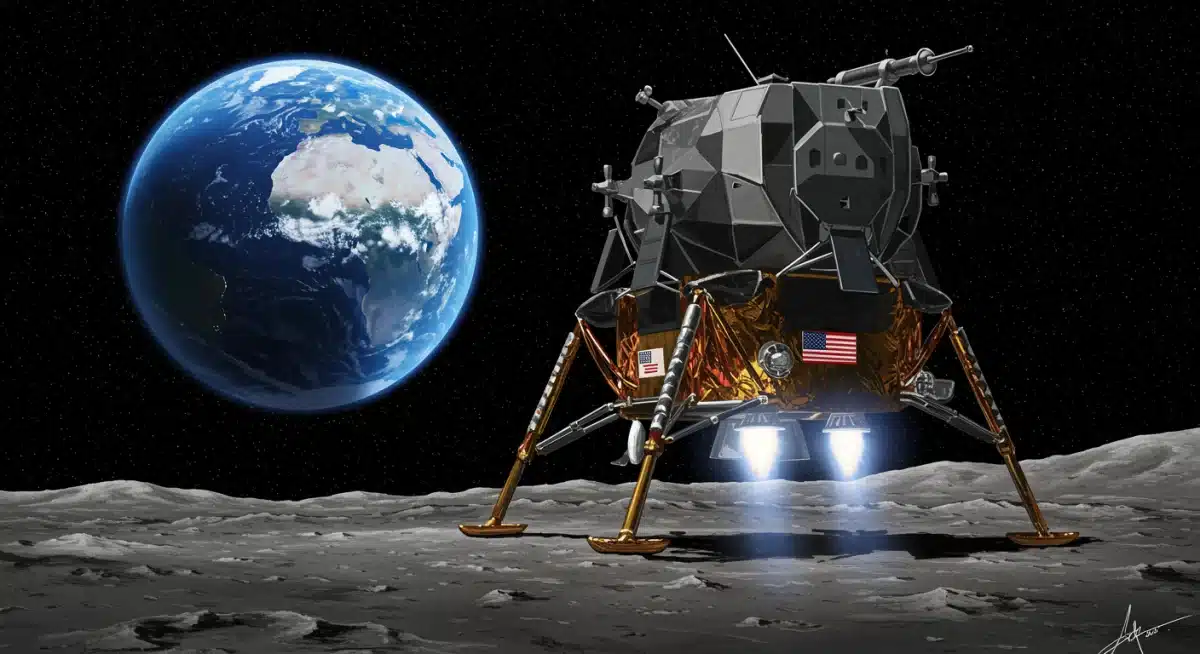
The exchange of knowledge and technology among participating nations accelerates innovation and builds capacity within the global space community. Each partner brings unique strengths to the table, creating a formidable team capable of tackling the most challenging aspects of space exploration.
Benefits of Global Space Partnerships
Collaborative efforts in space exploration yield numerous advantages, from shared financial costs to enhanced scientific outcomes and diplomatic gains.
- Shared Costs and Resources: Distributing the immense financial and technical demands of complex missions.
- Diverse Expertise: Bringing together the best minds and technologies from around the world.
- Enhanced Scientific Returns: Enabling more comprehensive data collection and analysis through broader participation.
- Diplomatic Relations: Fostering international goodwill and cooperation through shared ambitious goals.
The 2025 missions stand as a testament to the power of international collaboration. They demonstrate that while national agencies lead individual initiatives, the grand vision of exploring the cosmos is a shared human endeavor. These partnerships are crucial for establishing a sustainable and peaceful presence in space for generations to come, ensuring that the benefits of space exploration are enjoyed by all.
The Future of Human Presence on the Moon and Beyond
The 2025 missions are not isolated events but critical stepping stones toward a grander vision: establishing a sustained human presence on the Moon and preparing for crewed missions to Mars. The lunar landing rehearsal, in particular, is designed to inform the development of a permanent lunar outpost, where astronauts can live and work for extended periods, conducting scientific research and testing technologies for deep space travel.
A lunar base would serve multiple purposes. It could act as a staging point for Mars missions, allowing for the assembly and testing of spacecraft in a reduced gravity environment. It would also provide a unique laboratory for studying the effects of long-duration space travel on the human body, an essential prerequisite for interplanetary journeys. Furthermore, the Moon’s resources, such as water ice, could be utilized to produce fuel and breathable air, reducing reliance on Earth-supplied provisions.
Long-Term Vision for Space Exploration
NASA’s long-term strategy involves a phased approach, building capabilities and knowledge incrementally. Each mission contributes to the overarching goal of expanding humanity’s reach and understanding of the universe.
- Lunar Gateway Development: Establishing a space station in lunar orbit to support both lunar surface missions and deep space exploration.
- Mars Sample Return: Bringing Martian rock and soil samples to Earth for detailed scientific analysis.
- Human Missions to Mars: Planning and executing the first crewed journey to the Red Planet.
- Asteroid Exploration: Investigating near-Earth asteroids for scientific and resource potential.
The vision extends far beyond our solar system, with aspirations for interstellar travel and the discovery of exoplanets capable of supporting life. The 2025 missions, therefore, represent crucial chapters in an ongoing saga of human ambition and scientific endeavor. They underscore humanity’s innate drive to explore, to understand our place in the cosmos, and to push the boundaries of what is possible.
Anticipated Challenges and Mitigation Strategies
Executing missions of this magnitude, particularly those involving human spaceflight and deep space exploration, inherently comes with significant challenges. From technical complexities to external environmental factors, mission planners must anticipate and mitigate a wide array of potential issues. NASA employs rigorous testing, redundant systems, and extensive training to ensure the highest probability of success.
One of the primary challenges for lunar missions is the harsh radiation environment on the Moon’s surface and during transit. NASA is developing advanced shielding materials and exploring pharmaceutical countermeasures to protect astronauts. For deep space missions, the sheer distance presents communication delays and requires highly autonomous systems capable of making decisions without immediate input from Earth.
Overcoming Obstacles in Space Exploration
Careful planning and innovative solutions are essential to addressing the inherent risks of space travel. Every potential failure mode is analyzed, and contingency plans are developed to ensure mission safety and success.
- Radiation Shielding: Developing new materials and techniques to protect crew and electronics from harmful cosmic and solar radiation.
- Autonomous Systems: Implementing AI and machine learning for onboard decision-making and error correction, especially for distant missions.
- Advanced Life Support: Creating closed-loop systems that recycle water and air, crucial for long-duration missions.
- Robust Communication Networks: Designing resilient communication architectures to maintain contact across vast distances and potential interference.
The challenges, while formidable, are met with equally formidable engineering and scientific ingenuity. Lessons learned from previous missions, both successes and failures, are continuously integrated into new designs and operational protocols. The 2025 missions will undoubtedly provide invaluable experience, further refining our ability to overcome the daunting obstacles of space exploration and push the boundaries of human achievement even further.
| Key Mission | Brief Description |
|---|---|
| Human Lunar Rehearsal | Critical test for future crewed Moon landings, validating systems and procedures. |
| Deep Space Mission | Ambitious endeavor to explore beyond Earth’s orbit, seeking new scientific discoveries. |
| Artemis Program | NASA’s initiative to return humans to the Moon and establish a sustained lunar presence. |
| Technological Advancements | Innovations in propulsion, AI, robotics, and life support enable ambitious missions. |
Frequently Asked Questions about NASA’s 2025 Missions
The primary goal is to validate all critical systems, procedures, and human capabilities necessary for future crewed lunar landings. This includes testing the spacecraft, landing systems, crew operations, and communication protocols to ensure safety and mission success.
International collaboration pools resources, expertise, and technologies, sharing costs and risks. It fosters diplomatic ties, enhances scientific returns through diverse perspectives, and accelerates innovation, making complex missions more achievable and robust for all involved.
Key technological advancements include advanced propulsion systems for faster travel, AI and machine learning for autonomous operations, miniaturized scientific instruments for increased data collection, and robust communication networks to maintain contact across vast cosmic distances.
The long-term vision extends to establishing a sustained human presence on the Moon, developing a lunar outpost, and eventually undertaking crewed missions to Mars. These missions serve as foundational steps for deeper solar system exploration and potentially interstellar travel.
Major challenges include mitigating harsh radiation environments for crew safety, overcoming vast communication delays for deep space probes, ensuring the reliability of complex systems, and developing advanced life support for long-duration missions away from Earth’s protective environment.
Conclusion
The confirmation of two major missions for 2025, including a human landing rehearsal on the Moon and a significant deep space endeavor, marks a pivotal moment in NASA’s ongoing legacy of exploration. These missions are more than just launches; they represent the culmination of years of scientific inquiry, engineering marvel, and international cooperation. They are critical steps towards establishing a sustained human presence beyond Earth, pushing the boundaries of what is possible, and inspiring a new generation to look to the stars with renewed wonder and ambition. As humanity ventures further into the cosmos, the lessons learned and technologies developed from these 2025 missions will undoubtedly pave the way for even grander discoveries and a deeper understanding of our universe.
Autor